Guarding Your Financial Privacy Is Your Ultimate Wealth-Building Discipline
|
9
min read

Imagine walking up to a complete stranger on the street and handing them a master key to your front door, a detailed map of your daily routines, a list of your deepest anxieties, and a precise ledger of everything you own and owe.
Most people would never dream of doing this. Yet, millions of people do the exact digital equivalent every single day.
In our hyper-connected world, we have normalized trading our most sensitive information for marginal gains in convenience. We use sleek, cloud-based applications that connect to our bank accounts, aggregate our assets, and serve up colorful charts of our spending habits. We celebrate the ease of automated tracking while completely ignoring the invisible cost, the systematic surrender of our financial privacy.
Tracking your wealth is an essential habit for anyone serious about building financial independence. You cannot manage what you do not measure. However, where and how you track that wealth matters deeply.
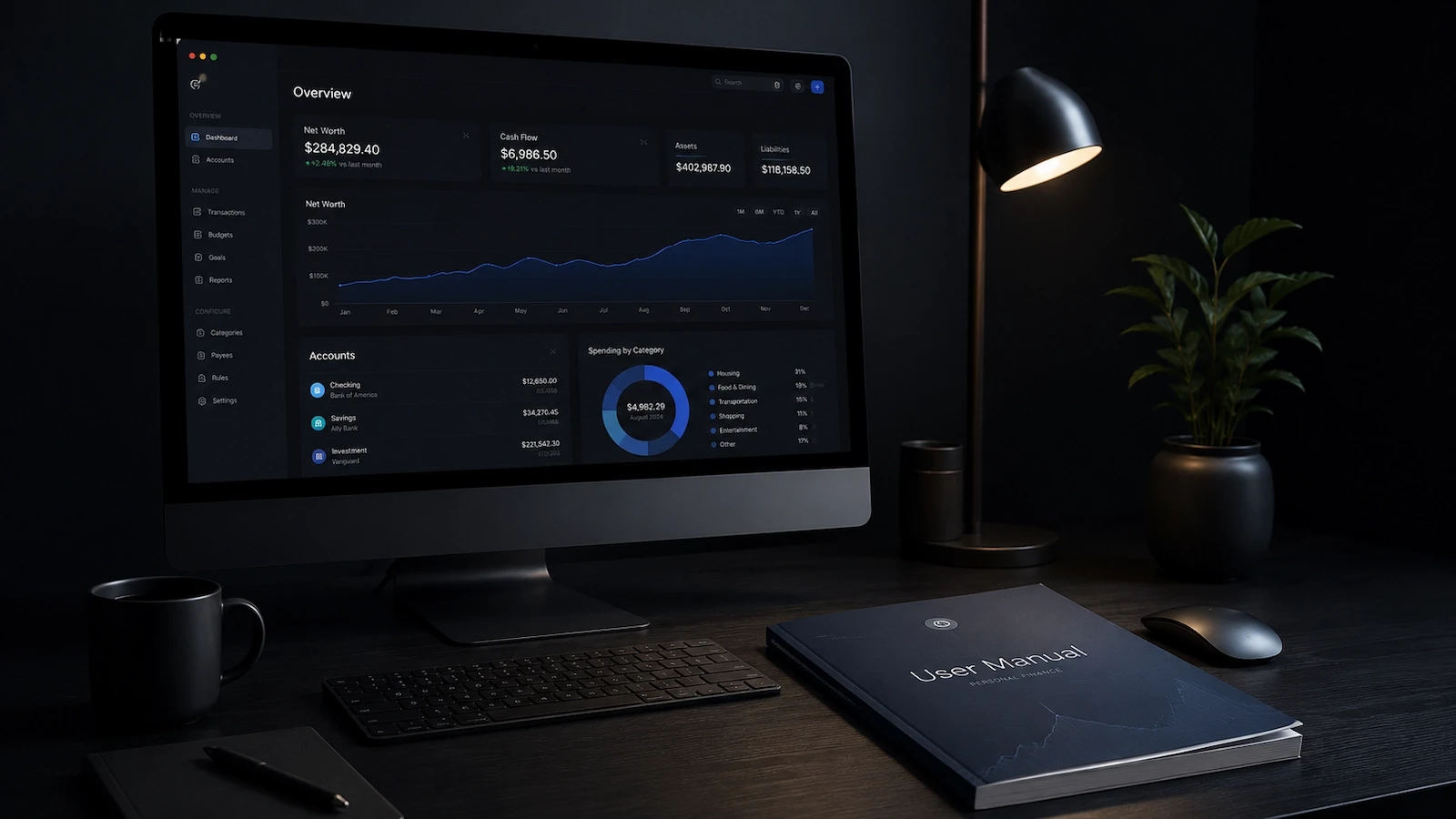
True financial sovereignty requires a shift in mindset. Protecting your data is not a paranoid, defensive reaction; it is a proactive, wealth-building discipline. By choosing local-first alternatives, such as an offline personal balance sheet software or a privacy first net worth tracker users can run locally, you reclaim control over your life map.
Your Financial Data Reveals More Than You Think
When we look at a personal balance sheet or a budget registry, we tend to see numbers, line items, and formulas. It looks like basic accounting data. To an external observer, data brokers, or an artificial intelligence model, that data is something entirely different, it is an incredibly accurate psychological profile.
Your personal financial records do not just show what you spent at the grocery store or what you owe on your mortgage. When aggregated over months and years, your financial data reveals:
Where you live and work: Transaction locations, utility bills, and payroll deposits pin down your exact geographic and professional footprint.
What you value: Your charitable donations, educational expenses, hobbies, and investments show exactly what matters most to you.
What you fear: Payments for insurance policies, legal retainers, security systems, or specialized medical treatments map your perceived vulnerabilities.
What you can afford: Your liquid cash reserves, credit limits, and asset appreciation rates define your exact economic purchasing power.
What stage of life you are in: Childcare costs, tuition payments, eldercare expenses, or retirement contributions signal your exact biological and social demographics.
What risks you are exposed to: Highly leveraged loans, concentrated stock positions, or variable-interest debts reveal where your financial foundation is fragile.
What you might do next: A sudden accumulation of cash, a sequence of travel bookings, or inquiries into business entities telegraph your future moves before you even make them.
This is not about fear-mongering; it is a practical reality of the digital age. Financial data is structured, clean, and highly searchable. It is the ultimate diagnostic tool for human behavior. When you upload this data to the cloud, you are not just storing numbers on someone else’s computer, you are publishing the behavioral code of your life.
Personal Finance Data Is a Map of Your Life
Money touches almost every area of human existence. Because every choice we make leaves a financial footprint, our financial records become an unedited, deeply intimate diary.
Think about the sheer breadth of information captured within a comprehensive wealth-tracking framework. A complete picture of your financial life explicitly exposes:
Salary, bonuses, and true earning power
Total debt levels, interest rates, and repayment timelines
Granular daily spending and consumption habits
Hidden medical burdens or family obligations
Investment portfolios, asset allocations, and personal risk tolerance
Travel patterns, flight frequencies, and lodging preferences
Lifestyle inflation and luxury spending thresholds
Private business interests, equity holdings, and side ventures
Dependents, family size, and household structural changes
Periods of intense financial stress, cash crunches, or vulnerability
A single transaction, isolated on its own, means very little. Buying a coffee or paying a one-time medical fee reveals next to nothing. The real exposure happens when small details are combined over time.
Years of categorized transactions, recurring payments, fluctuating asset values, and debt reduction histories form a composite picture. This longitudinal data reveals your macro life strategy. It shows how you react to crises, how quickly you recover from setbacks, and how you plan to navigate the future. Your financial map is a blueprint of your independence, and it deserves the highest level of protection.
The Problem With “Convenience First” Finance Tools
The modern fintech ecosystem is built on a simple premise: give us your data, and we will give you convenience. We are incentivized to link our bank accounts, credit cards, investment portfolios, and crypto wallets to centralized cloud platforms so we can see our net worth update in real-time.
This "convenience first" approach creates a massive structural trade-off. The more automated, helpful, and predictive a financial app becomes, the more intimate data it must collect, process, and retain. To give you automated insights, the software must read every line item of your life.
This dynamic has normalized a level of financial data sharing that would shock previous generations. Consider the paradox: most people would find it incredibly uncomfortable to publicly announce their exact net worth, their outstanding mortgage balance, or their monthly credit card debt to a room full of acquaintances. Yet, many of those same individuals casually upload that identical data into multiple unverified apps, browser extensions, and cloud platforms.
They do this without considering where the data is stored, who has administrative access to it, how securely it is encrypted, or how long it remains in a corporate database after they close their account. This critique does not mean every financial application is malicious or poorly built. Rather, it is a reminder to look at the equation consciously. When a service is free, or highly automated, your data is often the actual currency keeping the lights on.
Financial Privacy Protects Personal Security
There is a direct, undeniable link between financial privacy and your physical and digital safety. When detailed records of your net worth and asset composition live on external servers, you face real-world security risks.
Targeted Exploitation
If malicious actors or data brokers discover you hold significant liquid assets or a large cryptocurrency portfolio, you instantly become an attractive target for spear-phishing, social engineering, or physical extortion.
Exploiting Vulnerability
Conversely, if your data shows you are carrying deep debt, navigating a cash-flow crisis, or facing severe financial distress, predatory entities can exploit your urgency. They can target you with manipulative loans, high-fee restructuring scams, or fraudulent investment schemes when you are psychologically most vulnerable.
Hyper-Realistic Scams
Sophisticated bad actors do not just want your passwords; they want your context. If a scammer learns your exact recurring payment dates, the specific institutions holding your mortgage, or the precise net worth tracker or investment platforms you use, they can craft hyper-realistic, personalized phishing attacks. A fake email or phone call from your actual bank referencing your exact balance is almost impossible for the average person to spot as a fraud.
For individuals with complex financial lives, business owners, and high-net-worth investors, these risks scale exponentially. Keeping your balance sheet offline is not about hiding; it is about reducing your digital attack surface.
Financial Privacy Protects Your Decision-Making Freedom
Beyond physical and digital security, privacy preserves your mental independence. True financial health requires an environment where you can reflect on your money honestly, without being influenced by external incentives, targeted advertisements, or algorithmic nudges.
When your financial tracker is connected to the cloud, your data is constantly parsed to figure out what you should buy next. If the system notices you have a high cash balance, it pushes investment products. If it sees you are spending heavily on travel, it serves up premium credit card offers.
This constant feedback loop quietly shapes your desires and financial choices. It introduces noise into what should be a highly deliberate, personal decision-making process.
By utilizing a dedicated privacy-first net worth tracker application, you isolate your financial planning from the attention economy. You can look at your assets, evaluate your debts, and map your long-term strategies in a clean room, completely free from the manipulative monetization strategies of external platforms.
Net Worth Is Especially Sensitive
Many people confuse basic budgeting with net worth tracking. While a monthly budget tracks the short-term flow of water through the pipes, your net worth measures the size and stability of your entire reservoir.
Your net worth tells the ultimate story of your financial resilience. It shows everything you own (cash, real estate, brokerage accounts, private equity) balanced against everything you owe (mortgages, student loans, business debt). It reveals your true margin of safety and your capacity to handle a crisis or walk away from an unfavorable situation.
Because your net worth encapsulates your lifetime financial achievement, it is the single most sensitive piece of information you possess. Tracking it is absolutely vital for your long-term growth. If you do not know your net worth, you are flying blind.
The goal, however, is not to avoid measurement out of fear. The goal is to measure privately. You do not need a third-party cloud provider to validate your wealth building. You can achieve identical tracking precision, historical charting, and asset balancing by relying on local software that keeps your data where it belongs: under your direct physical control.
Privacy Does Not Mean Avoiding Technology
Choosing financial privacy does not mean abandoning modern software, reverting to physical paper ledgers, or acting like a digital hermit. Technology is a powerful tool for financial clarity, and you should use it. Protecting your privacy simply means choosing tools that respect digital boundaries.
The best financial software solutions help you understand your wealth deeply without requiring you to surrender your personal life history to a remote server. Excellent options exist for professionals who value both sophisticated tools and strict data boundaries:
Local-First Desktop Applications: Programs designed to run natively on your machine, storing all historical transaction logs and balance sheets within your system container.
Self-Hosted Solutions: For tech-savvy users, running a self-hosted personal finance app environment allows you to maintain total operational control over the database backend while accessing clean dashboards.
Offline Spreadsheets: Highly customized, formula-driven sheets that run entirely offline without external data connections.
You can have automated calculations, beautiful asset distribution pie charts, and comprehensive historical net worth chart while keeping your data entirely local. Technology should serve your wealth, not exploit it.
Financial Privacy Is a Wealth-Building Discipline
It is time to shift our perspective on privacy from a defensive, fearful posture to a proactive mindset. True wealth building is not just about accumulating assets; it is about risk management, capital preservation, discretion, and control.
Historically, the truly wealthy have always valued absolute discretion. They do not broadcast their financial positions because they understand that exposure creates liability.
When you treat your financial data with deep respect, you develop a highly disciplined relationship with your money. You stop viewing your balance sheet as a casual scorecard to compare with others online, and you begin viewing it as a sensitive, proprietary engine for your personal freedom.
Choosing a dedicated privacy-first net worth tracker or an offline database ensures that your wealth building remains focused, protected, and entirely yours.
Practical Ways to Keep Personal Finance Data Private
If you want to transition away from convenience-first cloud tools and establish a highly secure, private financial workflow, implement these practical, systematic steps:
Consolidate and Audit Your Financial App Footprint
Avoid spreading your financial footprint across dozens of micro-budgeting apps, net worth calculators, and stock trackers. Audit your current devices and delete platforms you no longer use regularly.
Before abandoning a service, check their privacy settings or contact support to explicitly request the permanent deletion of your historical data, linked account credentials, and analytical profiles from their backup servers.
Connect Accounts Only When Necessary
Be highly selective about account aggregation via third-party APIs. Ask yourself if the convenience of automated transaction syncing genuinely outweighs the long-term privacy trade-off. For long-term assets like real estate, retirement accounts, or private investments, manual monthly or quarterly updates on a local machine are highly secure and take only a few minutes.
Adopt Local-First or Offline-First Software
Make local data storage your default requirement for sensitive financial records. Prioritize high-quality offline personal balance sheet software that installs natively on your operating system. Finding a net worth tracker app native to your machine allows you to leverage robust system security while keeping your asset logs completely isolated from cloud data harvesting.
Build Secure, Encrypted Backup Habits
Private data storage does not mean fragile data storage. If your financial data lives exclusively on one laptop, you are one hardware failure or theft away from losing your entire financial history.
Protect your records by creating automated, encrypted backups. Use secure local external drives, encrypted disk images, or zero-knowledge, end-to-end encrypted cloud storage options where you alone hold the decryption keys.
Separate Daily Convenience From Lifetime History
Draw a clear line between operational everyday tools and long-term wealth records. It is perfectly fine to use a convenient mobile app to split a dinner bill with friends or quickly check a checking account balance.
However, your complete financial history, your total assets, liabilities, business equity, and multi-year net worth trajectories, should be separated from these casual tools and safely stored in a secure offline space.
Read Privacy Policies With a Critical Eye
Before entering information into any new personal finance tool, read the privacy policy specifically looking for data governance terms. Avoid apps that contain ambiguous language regarding data monetization. Look for explicit answers to these specific questions:
How is the data stored and encrypted?
Is data shared with or sold to third-party marketing networks?
Are my financial balances used to build anonymized profiling models for advertising?
What is the exact data retention policy when an account is closed?
Conclusion: Own Your Financial Sovereignty
Your financial journey is one of the most personal, defining projects of your life. Every dollar saved, every debt paid off, and every investment asset secured represents your time, energy, focus, and hard work. The map of those efforts belongs entirely to you.
Do not let the promise of minor convenience trick you into compromising your long-term security, peace of mind, and decision-making freedom. By adopting a local-first approach and utilizing tools like an offline personal balance sheet software, you insulate your financial life from data breaches, corporate tracking, and unnecessary exposure.
True financial independence is about total autonomy. Protect your financial map, secure your data, and build your wealth with the privacy, discretion, and control you deserve.