Why I Built GetMiryon for a Privacy-First Financial Future
|
7
min read
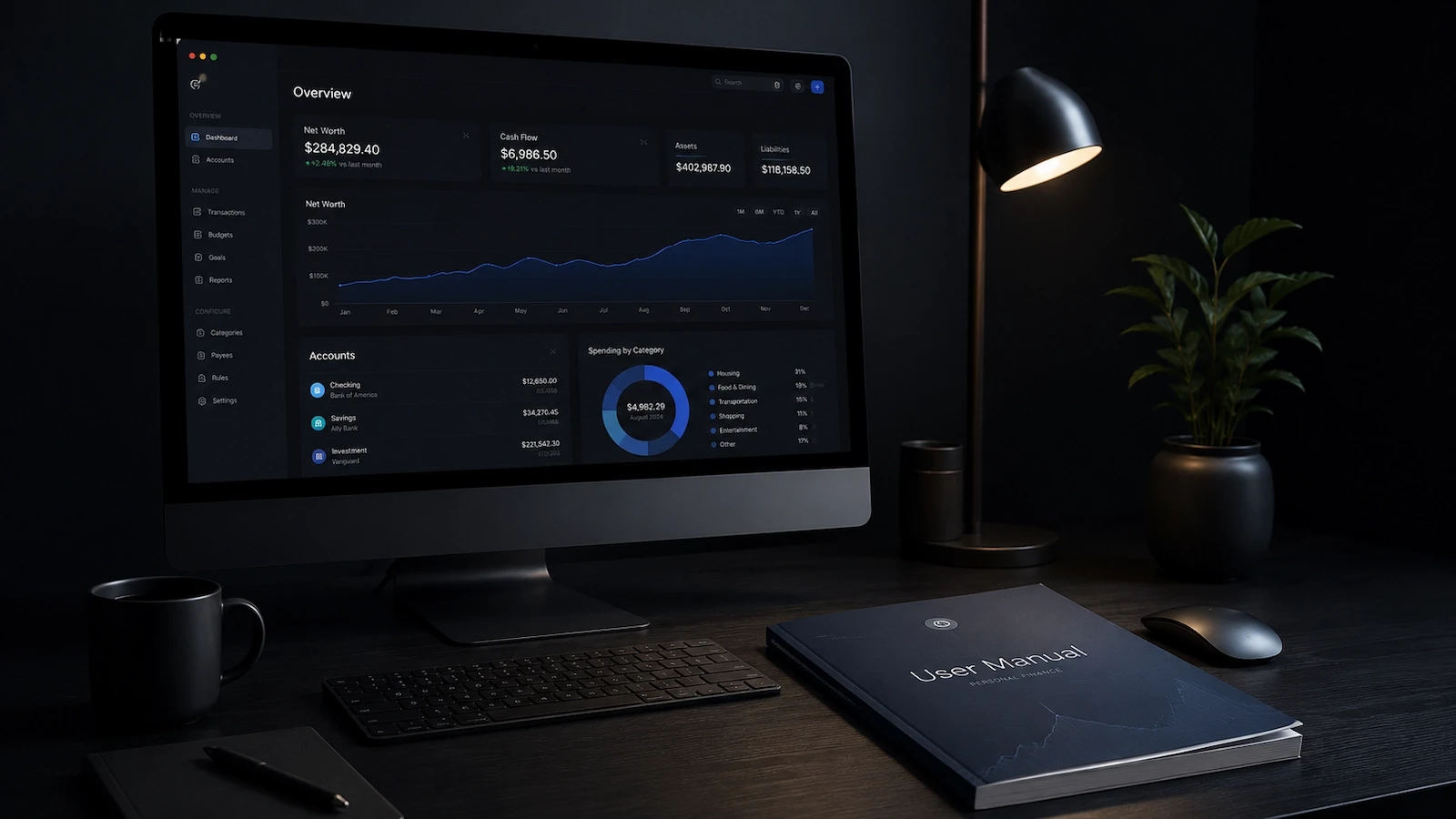
For years, my financial morning routine was predictable. I would open Spendee, log my morning latte, and ensure my daily categories stayed within their green zones. I still do this today. Tracking "coffee expenses" is a vital habit for maintaining cash-flow discipline. But as my financial journey matured, I realized that I was winning the battle of the budget while losing the war of wealth.
I had grown beyond the simple need to know what I spent; I needed to know what I was worth. I needed to track a personal balance sheet with the same rigor a CEO tracks a company’s health. However, as I searched for a tool to bridge this gap, I hit a wall, not of technology, but of philosophy. The current market for personal finance apps isn't designed for the user; it’s designed for the data harvester.
This is the story of why I walked away from the cloud and built GetMiryon.
The Workflow Angle: From Micro-Tracking to Macro-Strategy
Most personal finance apps on the market today are high tech digital checkbooks. They are hyper-focused on expense tracking and budgeting. While essential for beginners, these apps fail to help you manage the "big picture." They show you the groceries, but they don't show you the equity in your home, the fluctuating value of your brokerage accounts, or the slow burn of your long-term liabilities.
To manage this macro view, I, like many of you, turned to Excel. It’s the ultimate "blank canvas." But Excel has a high "maintenance tax." It requires immense discipline to keep the files updated, the formulas unbroken, and the data consistent across months and years. I found myself spending more time "fixing the spreadsheet" than actually analyzing my net worth.
The gap was clear: I needed an app that focused on the Personal Balance Sheet, a tool designed specifically to grow net worth rather than just categorize spending. But as I explored the modern app market, I encountered a much deeper problem: the Privacy Angle.
The Privacy Angle: Your Life, Their Cloud
While searching for a dedicated net worth tracker, I found several beautifully designed apps. Many had great features that I enjoy to use, but they all shared a common denominator: they were cloud-based, subscription-only web apps.
In the cloud-centric world of 2026, we’ve been conditioned to believe that "if it's not on the web, it's not convenient." But when it comes to my entire financial history, the exact balances of every account I own, I started to become increasingly prudent about data privacy.
The Continuity Risk: The Lesson of the Mint Shutdown
The true risk of cloud-based finance isn't just about security; it’s about continuity. When you rely on a third-party platform, you are essentially adopting their business model as your own. Look at the recent closure of Mint as a case study. After nearly two decades, millions of users were suddenly faced with a hard deadline to migrate their data or lose access to years of financial history.
While a migration path was offered, many found the new environment lacked the core tools they relied on, turning a simple transition into a scramble for alternatives. This forced users to manually export their history into CSV files, a process that is not only tedious but can be incredibly painful and overwhelming for those who aren't technologically savvy.
When your data lives in someone else’s cloud, important historical context is often lost in translation between platforms, leading to a frustrating period of "data amnesia." It serves as a reminder that when your financial life exists solely in a corporate cloud, your access is only as permanent as their current corporate strategy.
The Problem with Today’s App Models
The current landscape of personal finance software often presents a "convenience trap." While these apps look slick and automate many tasks, their business models are frequently at odds with your financial privacy and long-term security. They usually fall into one of these three structural traps:
1. The Subscription Trap: Paying Forever for Your Own Data
Modern software has shifted almost entirely to Software-as-a-Service (SaaS) models. While this ensures the developer gets a steady stream of revenue, it puts you on a "financial treadmill."
2. Data Harvesting: You Are the Product, Not the Customer
The phrase "if you aren't paying for the product, you are the product" is especially true in finance. Many "free" or low-cost apps don't make money from your subscription; they make money from your behavioral data.
3. Account Aggregation: The "Honey Pot" Risk
To provide "real-time" updates, most apps require you to link your bank credentials via third-party aggregators like Plaid or Yodlee. While convenient, this creates a massive, centralized security and privacy risk.
Why Your Financial Data Should Be Private
If you’re wondering why "total privacy" matters for a personal balance sheet, it is important to realize that this data is the "crown jewels" of your personal information. Unlike a budget, which shows how much you spent on groceries, a balance sheet reveals your total life’s work.
Consider these three critical reasons why this data should never leave your own machine:
1. Strategic Targeting and Price Discrimination
Your financial data is the ultimate profile for advertisers, scammers, and predatory corporations. When a company knows your exact net worth, your liquidity, and your debt-to-income ratio, they gain an unfair psychological advantage.
Price Discrimination: Companies can use "dynamic pricing" based on your perceived wealth. If an algorithm knows you have a high net worth and significant liquid cash, you may be shown higher prices for services, higher interest rates on loans, or lower yields on savings products.
Scam Magnet: A high-net-worth individual is a high-value target. In the event of a data leak, having your total asset list exposed makes you a primary target for sophisticated social engineering and "whale" phishing attacks.
2. Security: The Roadmap to Your Life’s Work
We often think of data breaches in terms of stolen emails or passwords, but a financial data breach is far more invasive. If a cloud database containing your balance sheet is compromised, the attacker doesn't just get a login; they get a strategic roadmap of your entire financial life.
Asset Discovery: They know exactly which banks you use, where your brokerage accounts are held, and how much equity is in your home. They know your vulnerabilities—which accounts are most liquid and which have the least oversight.
Permanent Record: Once this "snapshot" of your wealth is leaked, it exists on the dark web forever. Unlike a credit card number, you cannot "cancel" the fact that you own a specific property or have a specific amount in a retirement fund.
3. Loss of Leverage in an AI-Driven World
We are entering an era of AI-driven finance, where your data is no longer just stored—it is "consumed" to train models. When your data lives in the cloud, it is often used to train algorithms that may eventually be used against your interests.
Algorithmic Profiling: Insurance companies and lenders use big data to predict risk. If your balance sheet data is harvested, it could be used to train models that adjust your insurance premiums or deny you loan approvals based on "behavioral patterns" the AI identifies in your financial history.
Information Asymmetry: In any negotiation—whether for a mortgage, a car, or a salary—the person with the most information wins. By keeping your financial data private, you maintain your information leverage. You decide who knows what about your wealth, ensuring that no algorithm can pre-judge your financial capacity before you even sit down at the table.
My Solution: GetMiryon
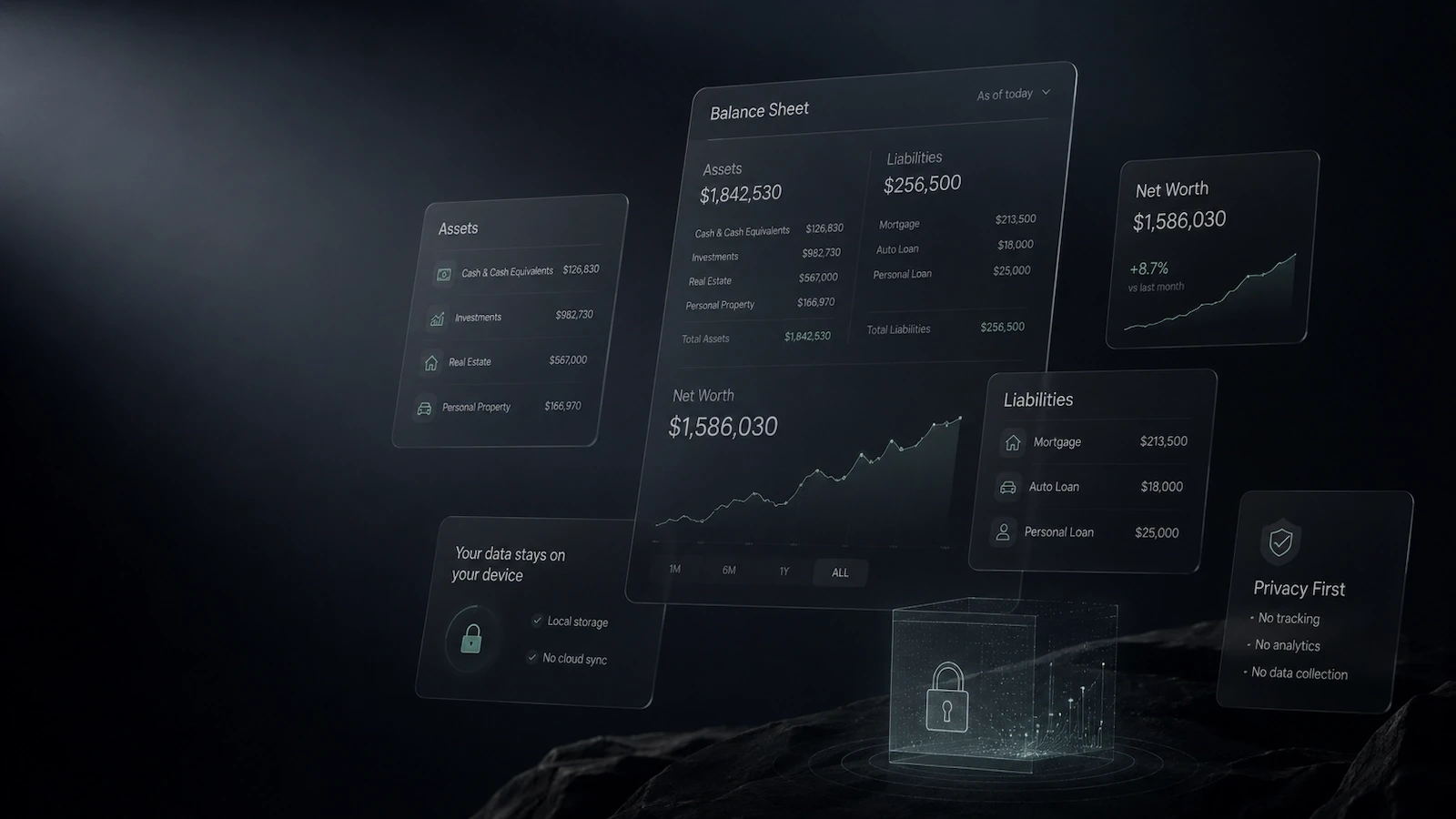
I built GetMiryon because I wanted a privacy-first desktop app that treated personal finance and balance sheet with the seriousness of a corporate audit.
GetMiryon is different by design. It is a local-first application.
No Account Linking: It does not link to your bank accounts. Your financial data stays with your financial service providers, where it belongs, and not with us or any third-party aggregators.
Local Storage Only: Every entry you create in GetMiryon stays on your machine. We do not have a cloud server for your data; we cannot see it, we cannot sell it, and we cannot "lock" you out of it.
Addressing the Desktop Disadvantage
I am often asked about the "inconveniences" of a desktop app. It’s true that a local app requires a slightly different mindset, but the tradeoffs are overwhelmingly in your favor.
1. Data Loss and Corruption
Because your data is local, if your computer dies, your data could die with it. However, this is easily mitigated. GetMiryon makes it simple to perform regular backups. You can encrypt the backup file and save it to a USB drive for total "air-gapped" privacy, or use your favorite cloud sync service (like iCloud, Dropbox, or Proton Drive). The difference? You are in control of the sync. You choose the encryption and you choose the provider.
2. Multi-Machine Access
You might worry that you can't check your balance sheet on your phone at the grocery store. But let’s be honest: a personal balance sheet is not something you need to access daily. Unlike an expense tracker, which requires real-time logging, a balance sheet is for "pulse checks" before major decisions or for monthly reviews.
If you do need it on two machines, you can simply install a second instance of GetMiryon and point it to your private cloud-sync folder.
3. The Export Standard
I believe every decent personal finance app should be a "glass box," not a "black box." GetMiryon features robust export tools. If you ever decide to move to another software, your data is available in portable formats. You are never "trapped" by GetMiryon; you are empowered by it.
Conclusion
Wealth building is a long game. It requires a tool that is as stable as it is private. I created GetMiryon for the person who wants to move beyond the "coffee budget" and start managing their legacy with the privacy and security that only a local-first desktop app can provide.
Your net worth is your story. It’s time you were the only one who could read it.